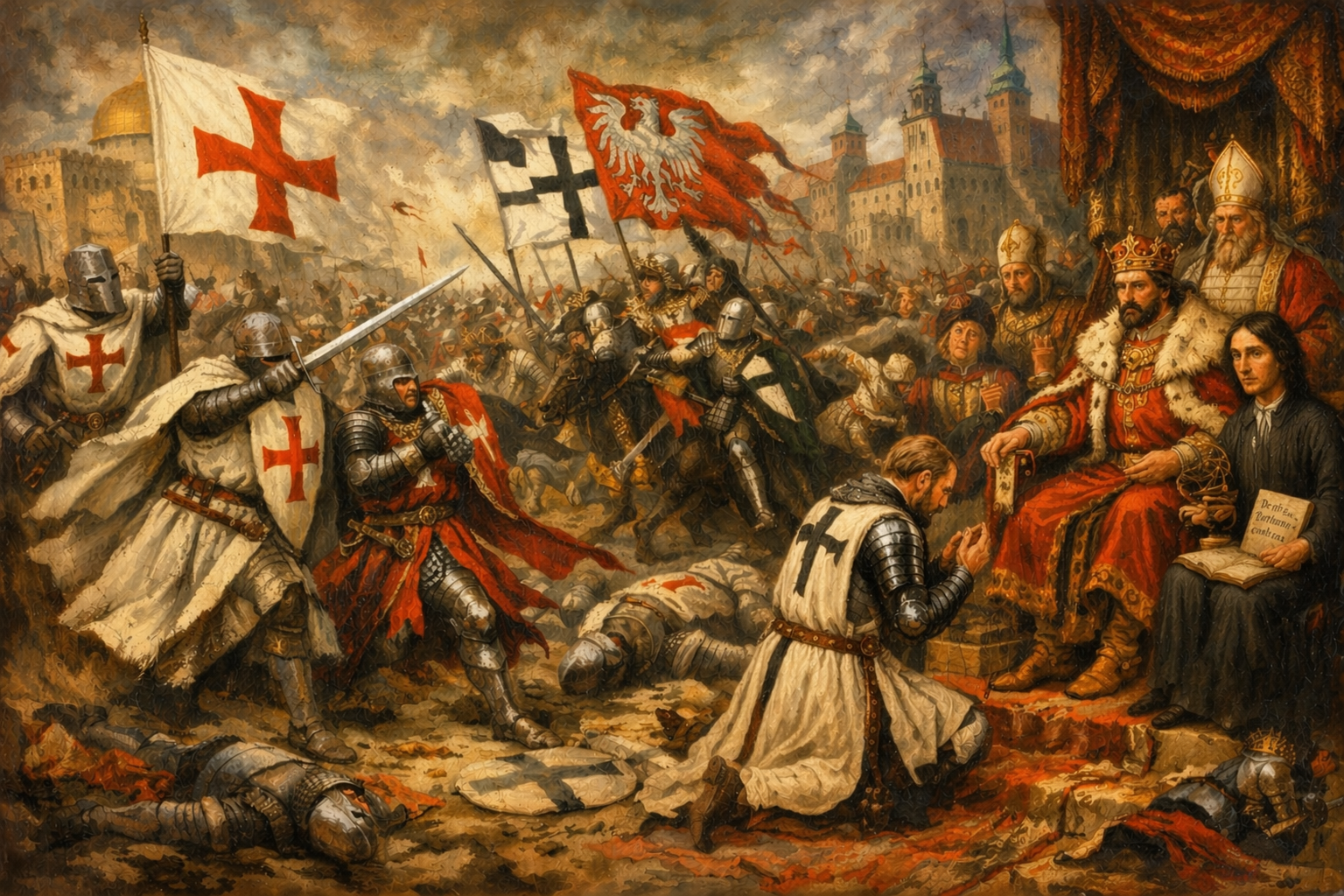
Medieval times were marked by the crusades in the Holy Land and the rise of two military orders that would make a large imprint on European politics. These two orders were the Knights Templar and the Teutonic Knights both of which were born in what we now refer to as the Middle East.
KNIGHTS TEMPLAR AND THE SEARCH FOR THE HOLY GRAIL
The crusaders were called by the Pope to wrestle Jerusalem from the Muslim Turks. Armies of European adventure-seeking knights joined these campaigns and eventually captured Jerusalem in 1099 establishing new states in the region of which most important was the kingdom of Jerusalem. Its first appointed ruler Godfroi de Bouillon subsequently patronized the formation of various religious and military orders. One of them was the group of knights who established themselves at Al-Aqsa Mosque, former site of the Temple of Salomon, hence their official name The Poor Fellow-Soldiers of Christ and of the Temple of Solomon, shortly Knights Templar or simply the Templars. One of its founding members, Andre de Mountbard, was a relative of Bernard of Clairvaux, the founder of Cisterian order. He studied gnosticism which drew from many ancient traditions Egyptian and Jewish which aimed to attain 'gnosis' - revelatory knowledge. Bernard hoped to create a community of knights poor materially yet spiritually awake and thus permanently wealthy.
The legend says that after years of excavations at Temple Mount the Templars discovered ancient treaties on sacred geometry, alchemy, architectural engineering and the foundation work of Jewish mysticism known as Kabbalah. Kabbalah which translates from Hebrew as 'tradition' is a set of esoteric teachings drawn from studying of the Torah and other ancient traditions which uses sacred geometry to explain the nature of God the origin and structure of the universe the dualist nature of soul and source of inner conflict within man. The Cabalists believed that studying of Kabbalah would give them control over the powers of the universe which according to Christians were only reserved to God. Kabbalah was one of the Templars' greatest discoveries. It was subsequently smuggled out to the Iberian Peninsula and published in the 13th century in a Hebrew work called Sepher ha-Zohar al ha-Torah, the Book of Splendor on the Law.
THE LEGACY OF THE TEMPLARS
The Templars were granted recognition from the Pope and started to use Red Cross on a white background symbol of martyrdom for the christian faith. They were subsequently granted land across Europe, built castles and strong navy and established first banking network by developing a system of credit notes and bookkeeping. Soon, they became very powerful organization hiring mercenaries farmers to cultivate land and masons to build large gothic cathedrals. They helped to repel the Muslims from the Iberian Peninsula being instrumental in the establishment of the state of Portugal. However, they became especially powerful in England where they acted as balancing power between the king and the barons.
Meanwhile, in the Middle East, the Turks were steadily pushing out the crusaders taking control of the Holy Land. After the fall of Acre 1291 all of the crusaders needed to evacuate . Knights Hospitaller took refuge in Cyprus then Rhodes and then in Malta becoming knights of Malta. As for the Templars, the French king Philip IV, who was gravely indebted towards the Templar Order, accused them of heresy, practicing cabalistic gnosticism and being beyond any secular or ecclesiastical authority. He then persuaded the Pope Clement the V to dissolve the order. Some Templars were arrested including the Grand Master of the Order Jacques de Moley whilst other went into hiding, some joining order orders like Teutonic Knights, others going to Scotland and the City of London and those in Portugal turning into Order of Christ later to be involved in Portugal's maritime expeditions.
Templars' legacy in Europe was much greater than the complex Gothic cathedrals chains of castles or stories of chivalry and romance. The Templars set a blueprint for the efficient cross-border multinational organization, modern banking, legal and parliamentary system in England. They helped the English to subdue Wales Scotland and Ireland. They laid foundation of the legal establishment in the Middle and Inner Temples in the City of London and later of Freemasonry which worked in the following centuries to undermine the power of the Roman Catholic Church and the established social order, and thus avenge the dissolution of the Knights Templar Order.
TEUTONIC KNIGHTS AND THE BUILD OF TEUTONIC STATE
Albeit the Knights Templar were very powerful they have never managed to create their own state as opposed to their comrade-in-arms, the Teutonic Knights. This Order was founded in 1198 in the Holy Land by the German crusaders from Bremen and Lubeck originally to care for the wounded hence their official name the Order of the Knights of the Hospital of St. Mary of the Teuton in Jerusalem. Lack of fighting men in the Holy Land forced them to transform into a proper military order. They were identified by a black cross on a white surcoat and shrewd diplomatic maneuvers through which they acquired land in Italy Germany and Palestine. However, as the Turks began to drive out the crusaders off the Holy Land they began to look for other crusading options. First they went to Transylvania on an invitation of a Hungarian king to fight with pagan Cumin tribes but as soon as the Hungarians realized they tried to establish their own autonomous state, they were expelled.
Soon thereafter, in 1226, they were invited to Poland by a prince Konrad Mazowiecki to help fight the pagans in Prussia, north of Poland, which they did but later turned against Poland and Lithuania. In 1308, they seized the strategically important territory of Pomerania at the Baltic coast with the Polish port of Gdansk blocking the Poles from possibility of exporting grain, one of their main export commodities. This brought the Teutonic knights into a conflict with Polish rulers. The Grand Master of the Order moved Order's headquarters from Venice to Marienburg (now Malbork in Pomerania region of Poland), making it the capital of new state, the Teutonic order state of Prussia. The Teutonic knights could now engage in commerce and admit their follow knights from England and Scotland who would usually come by sea. They also allowed the Company of Merchant Adventurers to open outposts in its cities of Gdansk and Elblag.
The threat from Teutonic Knights forced Poland and Lithuania into a union. One of the largest monuments in Krakow, situated near the main city gate, is representing the most famous battle in Polish history that took place in 1410 between the Teutonic Knights Order and the coalition of slavic knights, including Poles Lithuanians Czechs and Ruthenians who defeated the Teutonic knights and supporting them knights from England and France in one of the largest battles of medieval Europe. Polish chronicler Jan Dlugosz wrote that the first was the banner of the great land of Krakow, the sign of which was a white eagle in the crown which open wings in a red field.
In subsequent decades, the Poles won the support of merchants from Gdansk as well as from cities that were build by the Teutonic knights such as Torun and Elblag who no longer wanted be ruled by Teutonic knights. In result of subsequent wars the lands of Teutonic knights were reduced. The western part of Teutonic State with city of Gdansk became Royal Prussia, integral part of Poland, while eastern part with capital in Koningsberg (today's Kaliningrad) became a Polish fief. However, the Teutonic knights never came to terms with this territorial loss and decided to ally themselves with Duchy of Muscovy.
In 1517, Grand Prince of Muscovy, Tsar Vasili III, signed a military alliance with Grand Master of the Teutonic Knights, Albrecht Hohenzollern. Supported by the promises of Muscovy's military aid, Albrecht Hohenzollern demanded from Polish king return of Royal Prussia so the Polish parliament declared state of war and the Poles started to besiege Teutonic strongholds. One of the people involved in negotiations between the conflicting sides was the graduate of Krakow Academy, cleric and astronomer Nikola Copernicus. He came from a Prussian merchant family but acted as royal economist and diplomat representing the interests of the Polish Crown. He had by then already drafted his revolutionary thesis asserting that the earth moves around the sun thus making large contribution to the future scientific revolution in Europe.
THE BIRTH OF DUCHY OF PRUSSIA
Meanwhile, Albrecht Hohenzollern left Prussia and secretly met with Martin Luther who persuaded him join anti-Catholic coalition, convert to lutheranism and convert Prussia into a hereditary duchy for himself. Soon thereafter, Albrecht met with the Polish King Sigismund the Old offering to secularize the Order begging him not to incorporate Prussia to Poland. The king accepted his offer on condition that Duchy of Prussia remains a fiefdom of Poland. What happens next is the Prussian Homage 1525, the Grand Master kneeling before the Polish king on the main market square in Krakow which is now commemorated by a large plaque. Cardinal Hosius called the Polish king 'a madman who being in a position to crush the vanquished prefers instead to show mercy'.
So was born the Duchy of Prussia first protestant state in Europe and the only state that sprang up from a religious military order. The repercussions of this act would be grave not only for Poland but also for the entire Europe. From 17th century onwards, Prussia conspired with Russia to weaken the power of the Polish-Lithuanian Commonwealth. They helped the Muscovites to build powerful army to fight against the Poles and planted agents in the Russian court to control Russian politics. Almost throughout the entire 18th century Prussia controlled Russia with Cathrine the Great, Tsarina of Russia who took part in Poland's partitions, being actually Prussian princess. Prussia, being the main initiator of Poland's partitions, retained also strong afflictions with England and in the 19th century would unify all the German lands under its leadership and made Germany capable of putting entire Europe on its knees during the First and Second World Wars.
Who was the famous revolutionary Tadeusz Kosciouszko who fought against the combined Prussian-Russian armies trying to prevent the partitions of the Polish-Lithuanian Commonwealth? What were his links to Krakow, Freemasonry and the American Revolutionary War?
Well… that’s for next time.
So stay tuned, leave your comments - and if you prefer history with actual walking join me on my Free Walking Tours in Kraków.
Trust me… it’s much more fun (: