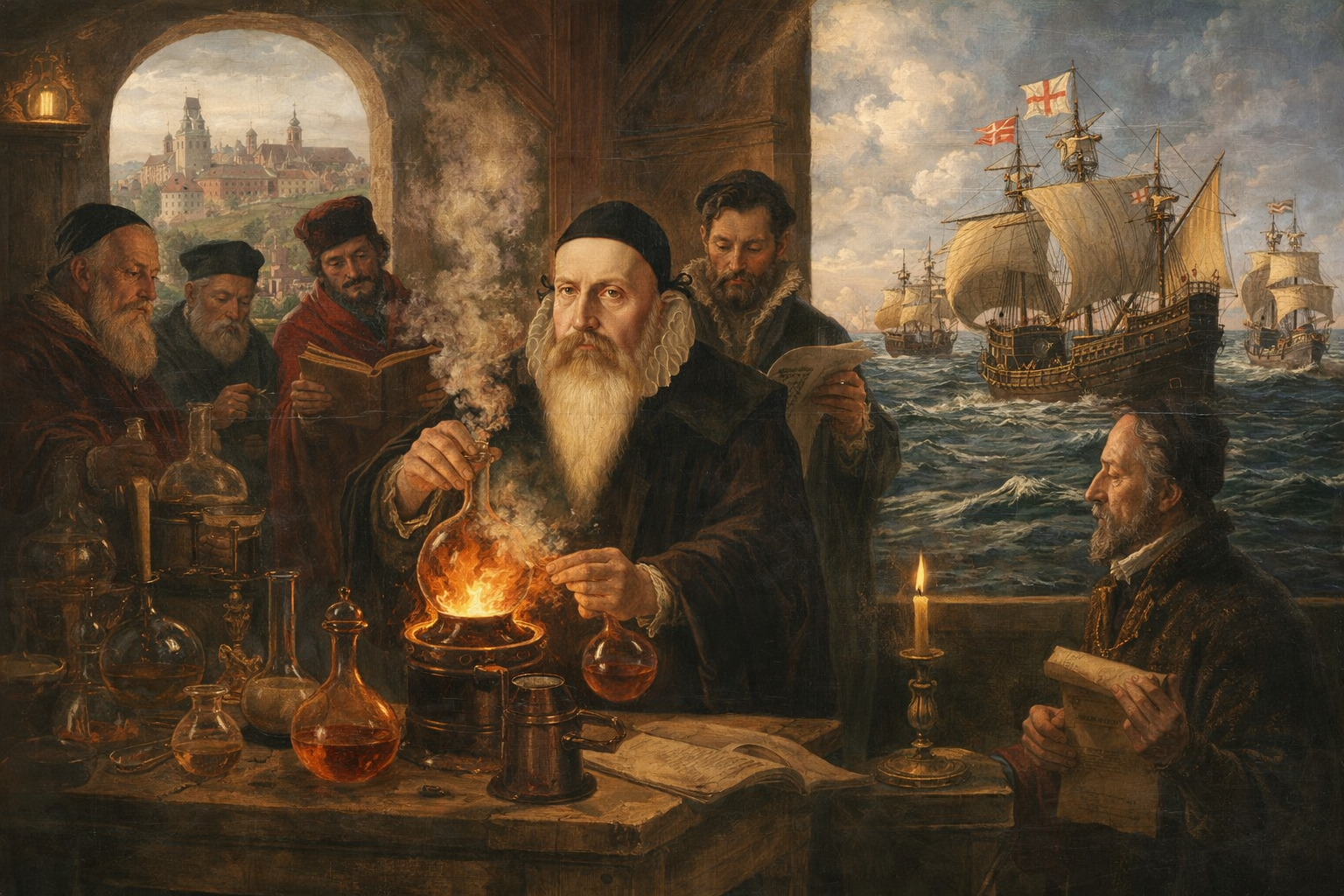
In the 16th century Krakow was the capital of the largest empire in Europe, Polish-Lithuanian Commonwealth that stretched from the Baltic Sea to the Black Sea, encompassing large part of present-day Poland, Lithuania, part of the Baltic states, Belorussia and Ukraine. It was a place of coronation of Polish kings and queens, a vibrant trading town but also a famous university town. The university established by Casimir the Great in 1364 was attracting foreign students. What made Krakow university different from other universities in Europe, it had a separate faculty of astronomy and astrology. You may ask a question how it was possible in Catholic Poland? Well...in late medieval and early renaissance times there was a large Jewish population in Poland who settled here escaping persecution in Western Europe. They brought with them knowledge about numerology, astrology, Jewish mysticism and Kabbalah.
Because of the presence of Jewish communities, Krakow and Prague became in the 15th and 16th centuries centers of alchemical practices. Alchemy, being a seriously regarded field, was a blend of chemistry, medicine, philosophy and spirituality. One of the main aims of the alchemical experiments was to find the 'philosopher's stone', a substance capable of turning metal into gold. Thus, Krakow, major centre of alchemical practices in Europe, was very attractive destination for the English astrologer and key advisor to the English court of Queen Elisabeth, Dr John DEE.
THE MERCHANT ADVENTURERS
16th century London comparing to Krakow was a backward uncivilized town and on the eve of the colonial era. Merchants of the City of London were swarming their way to the royal court taking reigns of power through the parliament and cutting ties with Roman Catholic Church. The church and the merchant class clashed on various grounds. Not only the Roman Catholic Church forbid issuing loans with interests which were necessary element of colonial expeditions but it was the largest landowner and had immense influence in the royal court. So England like in the times of Roman Britain rebelled and started to eliminate influences of the church also persecuting Catholics. At the same time English merchants were seeking trade routes to Asia bypassing the dominions of the Catholic powers of Spain and Portugal. With the Baltic trade sewn up by the Dutch competitors and the Spanish and Portuguese dominating in the southern sea, they navigated arctic waters hoping to reach America and Far East.
In 1551, the group of adventurers received a royal charter and founded the English Company of Merchant Adventurers to seek Northern Route to Cathay (which was the name for China) and Spice Islands. In 1553, they reached Archangielsk, a city and port in northern Russia and met Russian Tsar Ivan the Terrible. Russia was full in resources such as high-quality furs as well as timber, tar, pitch, hemp and masts needed for shipbuilding, whilst the Russians needed an ally in their war against the Catholic Polish-Lithuanian Commonwealth. When this merchant expedition returned to London the merchants delivered good news that Russia agreed to trade. Soon thereafter, the company was renamed into MUSCOVY COMPANY.
The merchants of the Muscovy Company in the City of London were assisted in their expeditions by the royal astrologer and occult philosopher John Dee. He absorbed knowledge as well as navigational instruments and maps in Holland from Gerardus Mercator and thus became key royal advisor in maritime expeditions. It was Dr Dee who presented Queen Elisabeth with the project of the 'British Empire' encouraging the Queen to assert England's claim to lands in North America. The ideas of Dr. John Dee encouraged London adventurers to attack Spanish and Portuguese vessels. Thus began the era of English privateering, slave trade and ruthless colonization.
DR DEE SPYING IN KRAKOW
Meanwhile, Dr Dee travelled to Krakow on a secret mission. As England was now an ally of Russia, Dr Dee's role was to travel to Catholic Poland and get in touch with Polish noblemen who conspired against Polish Crown like Samuel Zborowski. However, like all alchemists on the service of the royals, he was also searching for 'philosopher's stone', the formula to turn metal into gold. Krakow and Prague, full of alchemists, were ideal place for exploring these subjects. So Dr Dee, accompanied by Dr Laski, friend of Samuel Zborowski, arrived to Poland through Low Countries, North Germany reaching Krakow in March 1584. However, he could not stay in Krakow for a long time, as clouds were gathering above Samuel Zborowski and his supporters. In May, Samuel Zborowski was executed on the Krakow Wawel Hill for treason. Thus, dr Dee left Krakow in a hurry and went to Prague, the centre of occult arts and Jewish Kabbalah. Very soon, accused of spying for Queen Elisabeth, he made his way back London.
MARCH ON MOSCOW
Whilst Dr Dee spied in Catholic states, other agents of the City of London were operating at the Russian court. They assisted Ivan the Terrible in creating secret police, modeled on the secret police of the City of London under Francis Walsigham, which in turn was modeled on the Venetian Police. In Russia, in was known as oprichnina. So, after the death of Ivan the Terrible, the power was taken over by an oprichink Boris Godunov which started the civil war in Russia. Russian boyars and families of Shuiskys, Golisins and Romanovs started to plea Polish magnates to assist them in the overthrow of Boris Godunov.
Around 1604, a young man appeared at the court of Polish magnate Adam Wisniowiecki, claiming to be the son of Tsar Ivan the Terrible and seeking support to overthrow tsar Godunov. Some of the Polish magnates like Adam Wisniowiecki and Jerzy Mniszech saw this as a chance to ameliorate the relations with Russia but also recover some lost territories in the east. So Jerzy Mniszech, voivode of Sandomierz, agreed to support Dmitriy and gave him hand of his daughter, Marina Mniszech, if he becomes tsar of Russia and cedes some territories to Poland. Dimitry, surrounded by Polish troops, including hussar cavalry and some volunteer Cossack groups marched on Moscow 1604. The cities surrendered one by one. Although not all battles were won, the circumstances changed in favor of Dimiry as Boris Godunov suddenly died. Dimitry entered Moscow with the Polish guard and was crowned tsar Dmitri I. In November 1605, tsar Dmitri married by proxy in Krakow Marina Mniszech who then came to Moscow few months later to be crowned Tsarine of Russia.
Yet Dimitri's rule was short-lived. He was soon overthrown by other boyar families. Some of the Polish magnates supported a further imposter Dmitriy II which promoted tsar Vasili IV to make a military alliance with Sweden. The elected king of the Polish-Lithuanian Commonwealth, Sigismund III Vasa, motivated by the desire to recuperate the Swedish throne, declared war against Sweden and Russia. Some of the senators and military leaders like hetman Stanislaw Zolkiewski opposed the campaign representing traditional views of Polish nobility which did not support waging offensive wars. Yet, as king's servants they could not disobey the order.
What happens next is the siege of Smolensk and battle of Kluszyno 1610, one of the greatest victory of Polish hussar cavalry which defeated numerically superior Swedish and Russian armies. The Poles marched into Moscow. After 2 years of the Polish occupation of Kremlin, an uprising erupted against the Polish garrison organized by the merchant guild of Nizhny Novgorod under command of prince Dmitry Pozharsky with the respected town butcher Kuzma Mini overseeing the handling of funds donated by the merchants.
ENGLISH SUPPORT FOR MUSCOVITES
In their fight against the Poles, the Muscovites were supported by the English merchants. The merchants were worried about their commercial exemptions after king Sigismund III Vasa made it clear that he expected the English merchants trading in Muscovy to pay all duties. The Polish king also suspected that the aim of an earlier visit of English envoy Sir James Sandiland to Poland in 1609 was to offer mercenaries to Janusz Radzwill, one of the leaders of the rebellion against the king, so that he continues his resistance as means of diverting Polish attention from Moscow. Historical documents show that King Sigismund sent pleas to Queen Elisabeth in England to desist from sending arms to 'these barbarians ...because we know what they are like'. Eventually, the Poles occupying Kremlin were starved into surrender. The date of liberation of Moscow and Kremlin from Polish forces, November 4th, 1612, is a national holiday in Russia, whilst monument representing Kuzma Minin and prince Dmitry Pozharsky is adorning the famous Red Square in Moscow.
At that point in time, the Polish-Lithuanian Commonwealth was at the peak of its power and the territory of the Commonwealth spanned 1 million square km. Meanwhile, the link between the City of London and Moscow would flourish under the subsequent Tsar Peter the Great. He would travel to England, Prussia and Dutch Republic to hire engineers and experts who would help him to build the navy and army that would progressively destroy the Polish-Lithuanian Commonwealth.
What was the role of Duchy of Prussia in this process and what links did it have with the Templars in London? Why one of the main plaques on the Krakow Old Market Square mentions Prussian Homage?
Well… that’s for next time.
So stay tuned, leave your comments - and if you prefer history with actual walking join me on my Free Walking Tours in Kraków Old Town.
Trust me… it’s much more fun (: