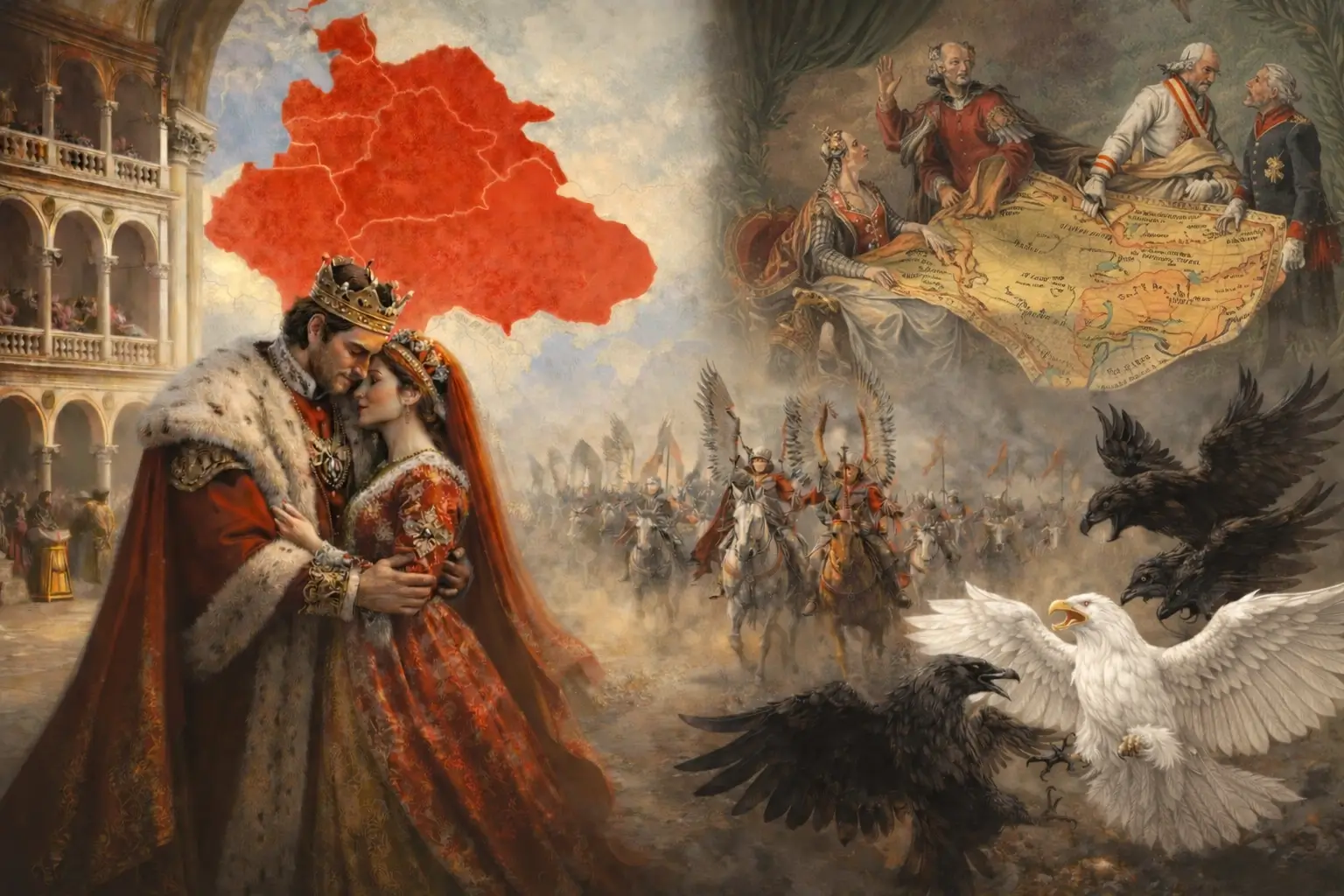
Let me start with a short introductory story explaining why Kraków is the most important town on the map of Poland.
CAPITAL OF THE POLISH-LITHUANIAN COMMONWEALTH
Today, when you arrive in Kraków, it looks like a nice medium-sized European town. Cosy charming manageable. But in the 16th century it was the capital of the largest empire in Europe. This empire stretched from the Baltic Sea to the Black Sea, encompassing large part of present-day Poland, Lithuania part of the Baltic states, Belorussia and Ukraine. It was called the Polish-Lithuanian Commonwealth - or, in short 'The Commonwealth', and in Polish language “Rzeczpospolita.”
It was huge, powerful and surprisingly diverse. Different cultures, religions, languages. Many Jewish people settled here, escaping persecution elsewhere and nearby Casimir district in Kraków became a major cultural and religious center of the Jewish community.
The Commonwealth was a class society ruled by a king and a privileged noble class that constituted about 10% of the population. Krakow was a royal capital of that Empire, it was a trading town, a university town and place of coronation of Polish kings and queens.
In the 16th century, Poland and Lithuania were ruled by the Lithuanian dynasty, the Jagiellonian dynasty, which solidified the alliance between the two nations. During the reign of the 6th king of this dynasty, Sigismund the Old, the famous Wawel Castle in Krakow now visited by circa 3 million tourists every year, was upgraded and re-built in the renaissance style making it the best example of renaissance architecture north of the Alps.
MOST FAMOUS LOVE AFFAIR IN POLISH HISTORY
Meanwhile, the son of Sigismund the Old Sigismund Augustus became most famous for marrying for love. Such phenomenon was virtually non-existent in royal families as they traditionally functioned as business deals designed to solidify alliances or establish peace between nations. So Sigismund's first marriage to Elizabeth, who came from a powerful Habsburg family, was arranged by the noble class. The marriage wasn't a happy one. Sigismund did not find Elisabeth attractive and looked for a mistress. During his stay in Lithuania, he fell in love with a young widow, Barbara Radziwiłł, daughter of a great Lithuanian magnate. When Sigismund's first wife Elizabeth died from an epileptic attack and shortly before taking the crown from his deceased father, Sigismund secretly married Barbara. You can easily imagine the scandal that had erupted in the royal court. Polish nobles and members of parliament, as well as king's mother Bona Sforza, were outraged by the monarchy's actions urging him to nullify the marriage. The objections arose not only because of the secret wedding without the nobility's consent but also because of the now rising influence of the Radziwiłł family. Despite all this pressure, the king stood his ground and said something surprisingly modern: that people should be free to love who they want. Bold move for the 16th century, isn't it?
Polish nobles relented eventually but not long after the wedding, following a period of illness, Barbara passed away. There were persistent rumors that she was poisoned and some implicated her mother-in-law Bona Sforza. The king fell into grief. Expecting to leave no legitimate hair he decided to change Poland constitutionally by uniting Poland and Lithuania into one state, changing hereditary monarchy into elective one. One country, one ruler elected by nobles. This system of elective monarchy, quite unique on European political scene, eventually created a lobby system where powerful states lobbied for their own candidates for the Polish Crown. And this in effect would weaken the royal power and become one of the main internal reasons for the fall down of the Commonwealth.
THE BIRTH OF THE NORTHERN ALLIANCE
Most importantly, however, the geopolitical situation started to change and this was linked to the religious wars in Europe. It is impossible to understand what happened in Europe in the 20th century, and how the power and alliances were shaped, without a reference to the religious wars in Europe and the birth of the so called "NORTHERN ALLIANCE".
So, in the 16th century, we have a split within the Roman Catholic Church. The merchant class which was growing in power started to subsidize a protestant movement in order to cut ties with the Roman Catholic Church and establish the church that would be subservient to the interests of the state. This was part of the power game. The Church was very strong at the time, had large influence on social and political life, was the largest landowner in Europe and population had to pay mandatory taxes to the church. At the same time the clergy was often abusing their power and that abuse was an argument used by German monk Martin Luther to argue that the Roman Catholic Church needed be reformed. To cut long story short, eventually two camps sprang up: The protestant and the catholic camp. In the protestant camp there were: Duchy of Prussia, Dutch Republic and England, some Germanic cities and lands and Scandinavian states. So, largely the states were merchant class was very strong. In the Catholic Camp there were: Polish-Lithuanian Commonwealth, France, Spain, Austria and the Papal States. Steadily, through a series of wars but also a system of masonic loges established across Europe, the protestant camp would be winning this game of power, diminishing the role of Roman Catholic Church and Catholic states in Europe. And they would co-operate and build the power of Russia to achieve this aim. This ani-Catholic alliance of England, Prussia, Dutch Republic and Russia was known by the initiated as 'Northern Alliance'.
THE WINGED HUSSARS
So, in the 17th century Poland started to feel the pressure from the conspiring states of the 'Northern Alliance'. Polish nobles had to fight series of defensive wars against the Russians, the Swedes, also the Turks who were advancing north and on the top of that the Cossacks who rose on the Ukrainian lands against Polish lords. For a long time, the Poles managed to win these battles thanks to superb military formations created by one of our best elected kings, Transylvanian Prince Stephan Batory. He turned light Hussar cavalry formation, originally Serbian and Hungarian mercenary cavalry into a heavily armored cavalry that turned Poland into a great military power. His hussars adopted metal-plated body armor and became equipped with the 18-21 foot long lance, much longer than their western equivalents. The hussars' charge started at a slow pace and in a relatively loose formation, gradually gathering pace and closing ranks before striking the adversary in full force in knee-to-knee formation. During victory parades, these hussar carried characteristic wooden frames with eagle, ostrich, swan or goose feathers, hence their name 'Winged Hussars'.
The hussars made spectacular achievements winning over the Russian, the Swedes and the Turks but after series of wars and especially after the Swedish invasions, Polish economy was virtually bankrupt. The largest noble landowners - the magnate class - were interested mainly in protecting their own estates turning the Commonwealth into a federation of small republics, each with its own army and foreign policy. Internally, the Commonwealth was a dysfunctional state with a weakening authority of the king, internal quarrels, lack of the effective taxation system and constant breaks up of the parliamentary sessions with one dissenting vote infamous LIBERUM VETO.
PARTITIONS OF THE POLISH-LITHUANIAN COMMONWEALTH
Members of 'Northern Alliance' took advantage of these weakness, both of Polish political system and of Polish character. By corrupting members of Polish nobility they placed Saxon dynasty on the Polish throne, whose role was to deplete Polish treasury and sabotage reforms. Armed associations were formed to fight growing Russian interference but these were eventually quashed by the Russian troops, which simply outnumbered them. Prussia, Russia and Austria ganged up on Poland and annexed some of its lands in first partition of Poland 1772. Austria albeit a Catholic country opportunistically joined this action.
Last elected king of the Polish-Lithuanian Commonwealth Stanislaw August Poniatowski attempted to pass reforms, taking part in the proclamation in the Polish parliament of May Constitution, first codified constitution in Europe, but it was too little too late. More lands were seized by Prussia and Russia in second partition of the Commonwealth only 20 months later.
At the same time revolutionary moods came to Poland from France and North America. A great hero of the American Revolutionary War, general, military engineer and professional revolutionary Tadeusz Kościuszko announced a rebellion in Kraków. Soon thereafter he granted civil liberty to the peasants to gain extra force to fight against the Russians but he also would be eventually defeated by combined armies sent from Prussia and Russia.
Thus, the game was over for Poland. The third partition in 1795 wiped out the once powerful Polish-Lithuanian Commonwealth from the map of Europe for the next 123 years. After the fall down of the Commonwealth its capital Krakow was in a miserable condition and it would have to be restored like the entire country.
What role the City of London had in the rise of Prussia and Russia? Why the British astrologer and key advisor to Queen Elisabeth, dr John Dee visited Krakow in the 16th century?
Well… that’s for next time.
So stay tuned, leave your comments - and if you prefer history with actual walking, join me on my Free Walking Tours in Kraków.
Trust me… it’s much more fun (: