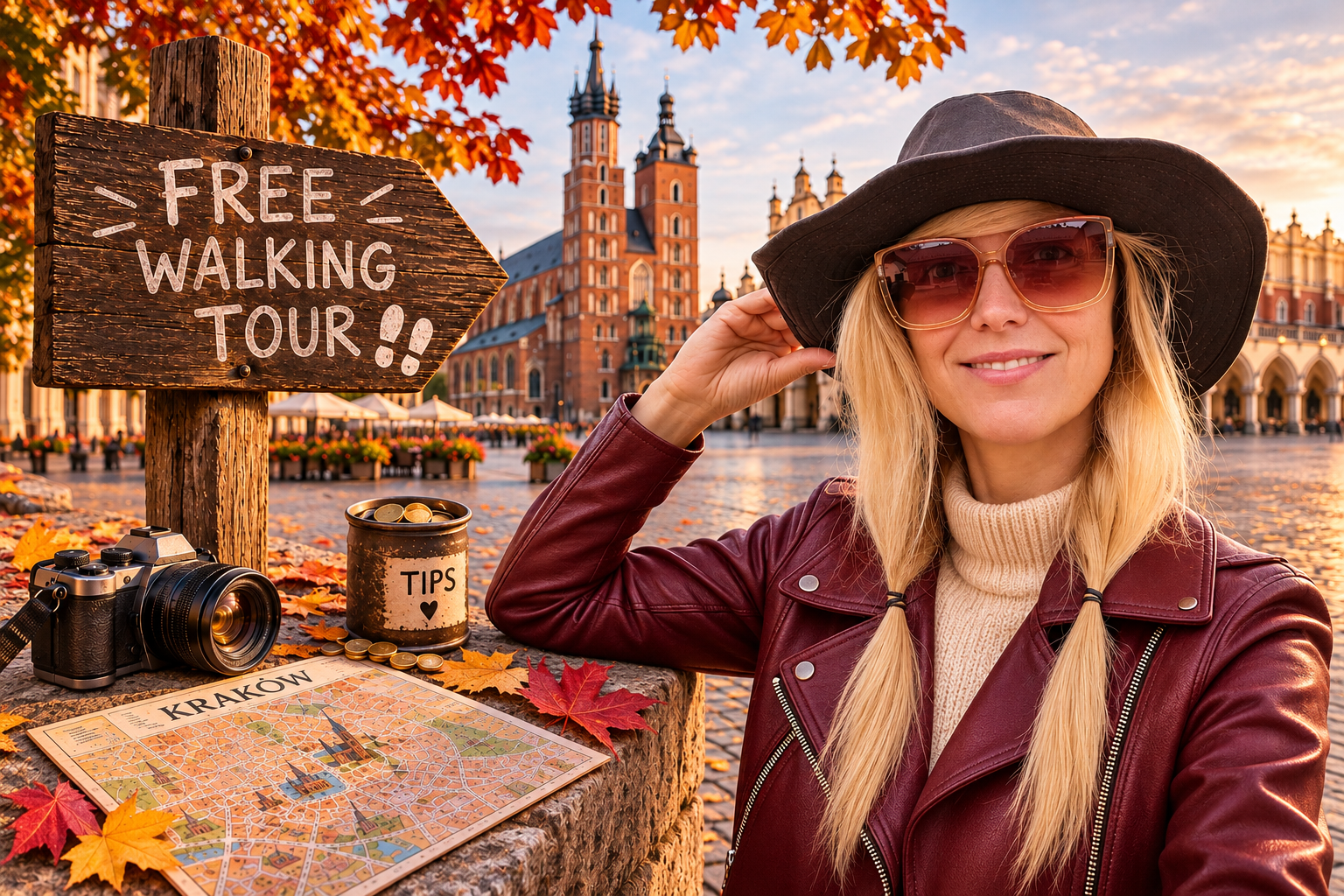
A heartwarming reflection on curious travelers, enthusiastic local guides and the extraordinary magic of exploring Krakow Old Town in the company of people who were complete strangers just moments before
There are two kinds of travelers in this world.
Those who arrive in Krakow Old Town with a detailed sightseeing itinerary, restaurant reservations, and a carefully organized spreadsheet dividing every attraction into neighborhoods and time slots.
And those who land at the airport, look around, and think:
"Well, here I am. Now what?"
At the beginning of a Free Walking Tour in Krakow, the group usually resembles a rather curious mosaic of humanity.
There is the couple who arrived fifteen minutes early.
The solo traveler pretending not to be nervous.
The history enthusiasts who always position themselves as close to the tour guide as possible.
The person who asks, "How long are we actually going to be walking?" despite having signed up for an activity that quite literally contains the words walking tour.
Then there are the curious tourists who notice a cheerful group of people laughing together with a guide and approach with hopeful smiles:
"Excuse me, is this a walking tour? Could we join you?"
And there is a young woman from China, fresh from the airport, carrying a backpack and pulling a tiny suitcase the delicate color of apple blossoms.
For the first few minutes, everyone stands around somewhat awkwardly.
People avoid eye contact, check their phones, adjust their backpacks, and pretend they have simply stopped for a moment, perhaps to ask for directions to Krakow's most fascinating historical landmark.
And then something changes.
People begin laughing at the same jokes.
They share umbrellas.
They help one another take photographs.
They exchange recommendations and travel stories.
Someone discovers that another traveler comes from the same country, or a town.
Or perhaps several people realize that they were brought into Krakow Old Town by the very same charming elderly gentleman driving a retro taxi, with a parrot on his shoulder.
Suddenly, these people are no longer complete strangers.
They are sharing a little adventure.
Fortunately, there is one experience that appeals to both kinds of travelers: a Free Walking Tour of Krakow Old Town.
It promises a delightful mixture of history, culture, fascinating local secrets, and unforgettable stories — perhaps even a little insider advice on where to find the best pierogi in Krakow.
Of course, anyone who has ever joined a Free Walking Tour knows that the word "free" comes with a rather intriguing philosophical question.
You don't pay anything upfront.
Instead, at the end of the tour, you decide for yourself how much the experience was worth to you.
And that simple idea makes the whole adventure surprisingly interesting.
1. Because You Pay What You Want – And What You Believe the Experience Is Worth
Perhaps that is one of the most beautiful things about traveling.
Let's face it.
Traveling costs money.
Hotels cost money.
Restaurants cost money.
Museums cost money.
In some European cities, even sitting down can cost money if you accidentally choose the wrong chair outside a café.
So when someone cheerfully announces:
"Free Walking Tour Krakow Old Town! Every day at 10:45 AM!"
A tiny spark of happiness immediately lights up somewhere in our brains.
Free?
In this day and age?
Please, tell me more.
It doesn't matter whether you're a backpacker surviving on apples bought from a local market stall or a comfort-loving traveler staying in a boutique hotel with seven decorative pillows arranged artistically across the bed.
Everybody appreciates a good deal.
But the most fascinating thing about these walking tours is that participants often end up being genuinely happy to pay.
Why?
Because paying for something you have already enjoyed feels completely different from paying for something before you even know whether it will be worth it.
In the first case, payment becomes an expression of gratitude.
In the second, it is something of a gamble.
Perhaps that is the real genius behind the entire concept of a Free Walking Tour.
It replaces an ordinary commercial transaction with something unexpectedly human.
A personal choice.
A gesture of appreciation.
A little moment of trust between a traveler and an enthusiastic local guide who has just spent a couple of hours bringing Krakow's history to life.
2. Because Deep Down, We All Want Someone to Explain What We're Looking At
Imagine standing in front of a magnificent medieval building.
You admire its towers.
You photograph its windows.
You wonder whether it is a church, a royal palace, or perhaps an unusually ambitious medieval post office.
And then you move on.
Now imagine standing in front of that very same building in Krakow Old Town, accompanied by a passionate local tour guide.
The guide tells you that centuries ago, a king once lived here.
A beautiful princess wandered through its corridors, dreaming of the handsome prince who might one day appear and steal her heart.
And somewhere behind the bricks of the royal treasury, an architect supposedly concealed a leather purse filled with gold coins.
A treasure that, according to the story, remained undiscovered for four hundred years.
Suddenly, it is no longer just a building.
It is a story.
And human beings love stories far more than architectural classifications.
A wonderful Krakow walking tour guide transforms streets into chapters, statues into characters, and historical events into episodes of a wonderfully complicated television series.
A series that might be called:
"What on Earth Did They Imagine the Year 2000 Would Look Like While Attending Wierzynek's Famous Feast in 1364?"
Imagine Krakow in 1364.
Kings, princes, diplomats, and distinguished guests gathering in a city that had become one of Europe's great diplomatic and social centers.
The famous Congress of Krakow.
The legendary feast associated with Wierzynek.
The conversations, political intrigues, magnificent clothing, royal ambitions, and perhaps a little medieval gossip exchanged over dinner.
What did those people dream about?
What did they fear?
What did they imagine the distant future would bring?
Without a guide, a city may appear to be nothing more than a beautiful collection of old stones.
But with a passionate storyteller by your side, those stones become guardians of history.
And slowly, wonderfully, they begin to tell their stories.
3. Because History Is Much More Interesting When Nobody Is Going to Test You Afterwards
Many of us spent years at school memorizing historical dates, battles, royal dynasties, and the names of kings.
We studied.
We memorized.
We passed our exams.
And then, with remarkable efficiency, we forgot most of it.
Yet something extraordinary happens when those very same people arrive in Krakow for a holiday and join a Free Walking Tour led by a charismatic local guide.
Suddenly, they transform into passionate amateur historians.
"Wait, wait, wait. So you're telling me that the king married his cousin, buried a treasure of gold beside a barrel maker's fence on a moonlit night, and then disguised himself as a wandering musician before setting off to explore the world?"
"Exactly."
"That's incredible!"
Of course, the difference lies in the storytelling.
A truly great tour guide does not simply recite facts and dates.
A great guide explains why something mattered.
What people may have felt.
What they hoped for.
What they feared.
And why an event that happened six hundred years ago can still seem hilarious, tragic, absurd, touching, or strangely familiar today.
History stops being a collection of information.
It becomes a fascinating story about real people.
People who fell in love, made mistakes, dreamed of greatness, argued with their neighbors, worried about money, and occasionally made decisions that would leave future generations scratching their heads in disbelief.
And the best part?
Nobody is going to make you write an essay about it afterwards.
Unless, of course, you happen to be a travel blogger.
In which case, that is an entirely different story ...